

AI is an amplifier
AI doesn’t create value.
It amplifies it.
And if people aren’t clear on how they create value — how they think, where their judgment matters, what should not be offloaded — AI doesn’t improve performance.
It amplifies:
– Weak thinking
– Misapplied effort
– Low-quality output at scale
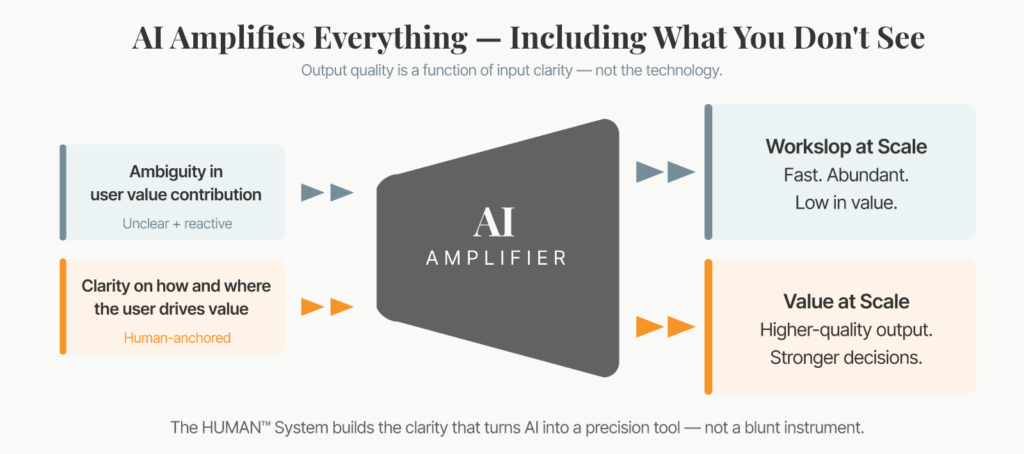
Recent research highlighted in Harvard Business Review describes the rise of what some are calling “workslop” — AI-generated output that is fast, abundant, and often low in value.
That’s not a failure of AI.
It’s a failure of clarity in the value of human input at various stages in AI use.
Why "Using AI" Isn't the Same as Improving Outcomes
Organizations are in a mad rush to implement AI in the quest for faster, better outcomes and to stay competitive.
But very few are clear on:
- Where AI should be applied
- Where human judgment is essential
- How to integrate the two effectively
So what happens?
People default to one of two patterns:
- Over-reliance on AI outputs (without sufficient judgment)
- Underuse of AI (because it doesn’t feel trustworthy or useful)
Neither improves performance.
Both create inconsistency — and over time, diluted value.
The HBR research makes this clear: when employees feel like passengers in AI adoption rather than active participants, engagement drops and output quality suffers. Their data shows:
Employees who feel forced to adopt AI report a 65% higher rate of producing workslop than those who feel genuinely empowered to direct it.
The tool isn’t the problem. The absence of a clear human operating foundation is.
The Missing Layer: Clarity on Human Contribution
Most AI strategies focus on the tool.
Very few focus on the human.
But the real leverage point isn’t the technology.
It’s understanding how people create value in the first place.
That includes:
- How they process information
- How they make decisions
- Where their judgment creates differentiation
- What should remain distinctly human
Without that clarity, AI becomes a blunt instrument.
With it, AI becomes a precision tool.
This is the gap the HUMAN™ System is built to close.
What Changes When You Get This Right
When individuals and organizations are clear on how value is created, AI use becomes intentional, not reactive.
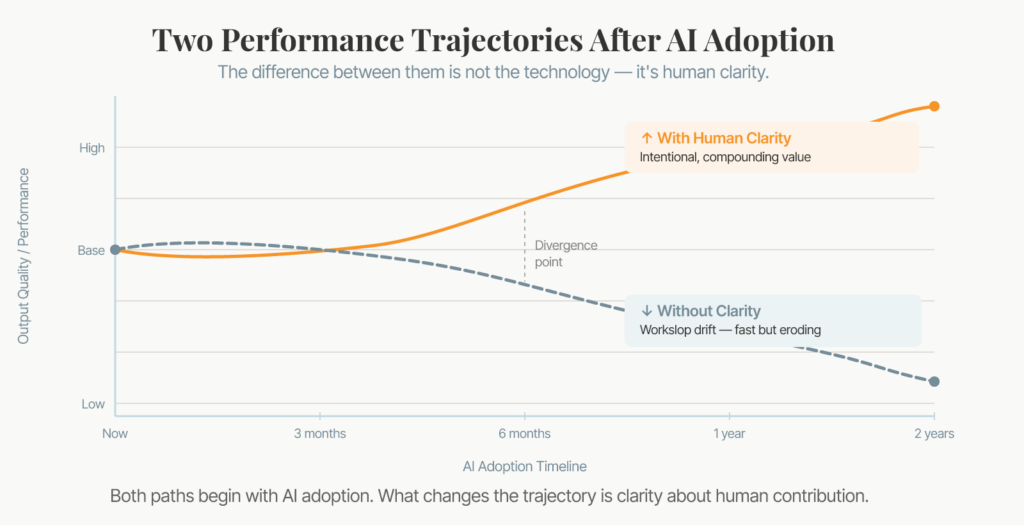
You start to see:
- Higher-quality output, not just faster output
- Stronger decisions, not just more analysis
- Clearer ownership of thinking and outcomes
- More differentiated contributions across teams
This is the difference between scaling activity and scaling value.
From Theory to Practice
This is where most organizations get stuck.
They understand — conceptually — that human judgment matters.
But they don’t have a structured way to make it visible or actionable.
That’s the gap.
The HUMAN™ System is built to make that clarity explicit — so people can understand how they operate, where they create value, and how to apply AI in a way that strengthens, rather than replaces, their thinking.
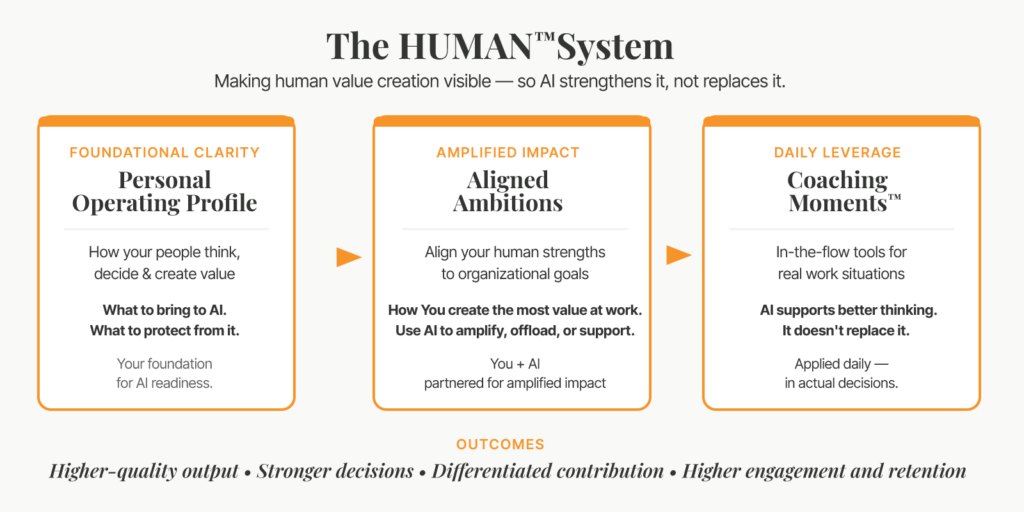
Personal Operating Profile
A clear articulation of how someone thinks, decides, and creates value — giving them a foundation for understanding what to bring to AI, and what to protect from it. This isn’t a personality assessment. It’s a working map of how you operate and where you create differentiation.
Aligned Ambitions
Where that clarity becomes applied. This layer connects individual strengths to real work — aligning how someone creates value with team priorities and organizational goals. It clarifies where AI should amplify effort, where it can offload tasks, and where human judgment must remain central.
Coaching Moments™
In-the-flow tools that help people apply that clarity in real work situations — reducing the most common failure mode: using AI to avoid thinking, rather than to sharpen it. These moments reinforce better decisions, not just faster ones.
For organizations, the work typically begins with a team pilot. A shared language around how people create value becomes the foundation for how AI is integrated — intentionally, not reactively. From there, alignment to real work and daily application ensures that clarity doesn’t sit in a document — it shows up in decisions.
That progression — clarity, alignment, application — is what separates teams that compound their output quality from those that quietly dilute it.
What This Can Look Like in Practice
When a team has a clear picture of how its people create value — and a structured way to apply AI against that clarity — the change in output quality isn’t subtle.
The pattern that tends to emerge: people stop using AI to produce faster versions of the same work, and start using it to do better versions of harder work. Decisions become more deliberate. Output becomes more differentiated. Ownership of thinking becomes visible in ways it rarely was before.
And critically, the question shifts — from “how do we use AI?” to *how do we use AI to leverage our judgment and creativity?“
That shift isn’t driven by the technology. It’s driven by the clarity that precedes it.
Getting it Right
The organizations that benefit most from AI won’t be the ones who adopt it fastest.
They’ll be the ones who:
- Understand how their people create value
- Design work around that reality
- Use AI to strengthen human judgment — not bypass it
That’s exactly what the HUMAN™ System is designed to support — and why forward-thinking teams are beginning to build this clarity into how they approach AI adoption from the start.
Where to Start
If you’re seeing faster output but not better outcomes, this is the place to look — not at the tool, but at how people are using it.
For organizations and people leaders:
If you’re leading AI adoption for a team and want to explore what building this clarity could look like — as a pilot, a team initiative, or an individual leadership investment — [schedule a conversation].
For individuals:
If you’re ready to get clear on how you create value — and how to bring that to AI intentionally — [start with the free Strength Architecture assessment. It takes about 15 minutes and gives you a genuine foundation to work from].
That’s where performance either compounds…or quietly erodes.
